
MAPS Intelligence
Resources/Practical Guides
Practical Guides · 8 min read

Retail: reading the catchment area, competing banners and store customers

For retailers: how to read a market made of stores, assortment and perceived price, and why your competitors are the other banners in your catchment area.

Updated October 6, 2026 · MAPS editorial team
In brief

For a retail banner — a chain, a store network, physical and online — the market is read by catchment area, assortment and perceived price. Your real competitors are the other banners in the same catchment area and online-only stores; suppliers are not competitors. The numbers that matter are store numbers: traffic, conversion, average basket, visit frequency.

What changes when the brand is the retailer

  • The network is the product. Formats, store locations, openings and closures matter as much as the offer.
  • Assortment is a strategic choice. Breadth versus depth, private label versus supplier brands.
  • Price is a game of perception. On the products customers compare, and on promotions in whatever form they take in your sector.
  • Retail isn’t just grocery. A fashion banner and a grocery banner have formats, seasons and promotions that look nothing alike: everything has to be read within the right merchandise category.

How to read the market, in five steps

1. The competitive set by catchment area

The banners serving the same customers in the same territory, plus online stores. A brand that manufactures products and also sells to you is a supplier, not a competitor.

2. Competitors’ networks, formats and assortment

How many stores, in what format, where they’re opening and closing; what they put on the shelf; how they push their private label. This is where you see how they take share of wallet.

3. Perceived price

The products customers use to judge value, the strategy — everyday low prices or frequent promotions — and the weekly circular or the sales, depending on the sector.

4. The voice of store customers

Store reviews, read by catchment area: service, wait times, availability, cleanliness, staff. They’re retail’s equivalent of social listening.

5. The shopper journey

From online search to the store and back: in-store pickup, app, loyalty card, local marketing. Where you lose the customer between one channel and the next.

The most common mistakes

  • Reading a retailer with a manufacturer’s metrics. What counts is traffic, conversion, average basket, turnover.
  • Mistaking suppliers for competitors.
  • Applying one sector’s rules to another. Fashion and grocery don’t promote the same way.
  • Making up competitors’ numbers. If they aren’t public, they should be declared unavailable.
How MAPS does it

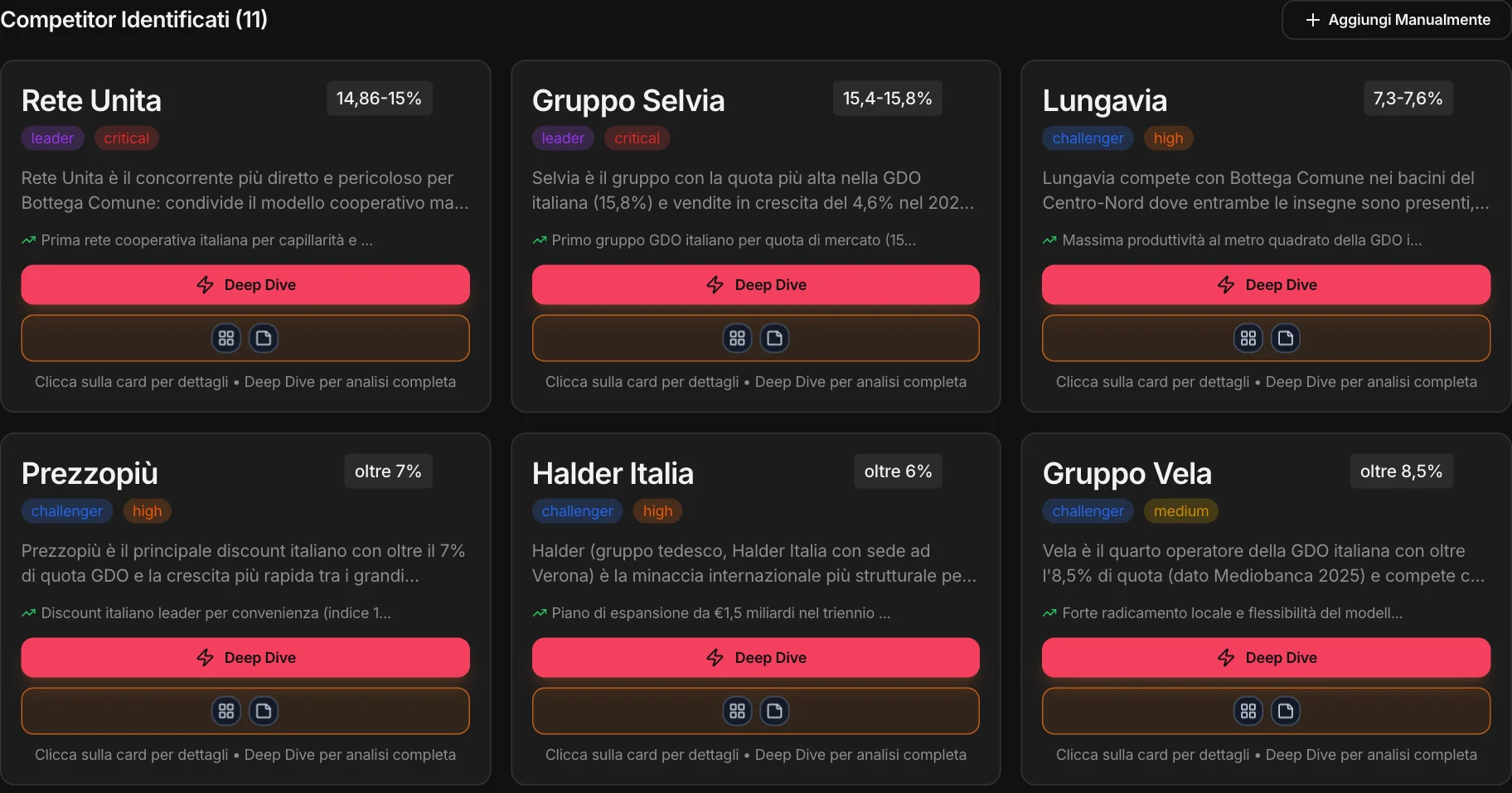
With the Retail industry profile, MAPS reads the brand as a retail banner: competitors are the other banners in the catchment area and pure players; a competitor deep dive looks at the network and the assortment and ends with how that competitor takes share of wallet; go-to-market is the network itself — formats, company-owned stores, franchising, openings. Listening reads store reviews by catchment area; the Analyze tools become shopper journey, pricing built on the products customers use to judge value and on the banner’s price perception, and a marketing mix in which “the network is the product.” Retail KPIs that aren’t public are marked N/A. The profile combines with B2B and Startup.

MAPS Competition Focus for a grocery retail banner: the other banners in the catchment area with role, threat and share (fictional names)

Frequently asked questions

Is a food brand sold in supermarkets “retail”?

No: the Retail profile is for those who are the retailer. A brand sold through grocery chains is still a consumer brand, and the supermarkets are its channels.

Does MAPS know competitors’ revenue?

Only when it’s public. Unavailable numbers are marked N/A, never estimated without saying so.

Does it work for any merchandise category?

Yes: fashion, grocery, electronics, home. Formats, seasons and promotional levers are read within your banner’s merchandise category.

How are store reviews read?

By store and by catchment area, looking for recurring themes: service, availability, wait times, prices, staff.

Written by the MAPS editorial team with the help of AI, checked and reviewed by the team.

Related articles
Practical Guides·8 min di lettura

Hospitality: reputation, the competitive set and the seasons to fill

For hotels, restaurants and venues: how to read your real competitive set, your reviews, the mix of direct and intermediated bookings, and the occasions worth owning.

Read →
Methodology·9 min di lettura

Competitive Intelligence: a method for gathering data that matters

From questions to decisions: how to plan, gather, verify and interpret information on competitors and the market — ethically, with sources and dates.

Read →
Strategic Tools·10 min di lettura

Customer Journey Map: how to build it channel by channel

Stages, touchpoints, emotions and critical moments of the buying journey: why a journey per channel is worth more than a generic one, and how to use it to decide where to act.

Read →