One click,
or a guided path.
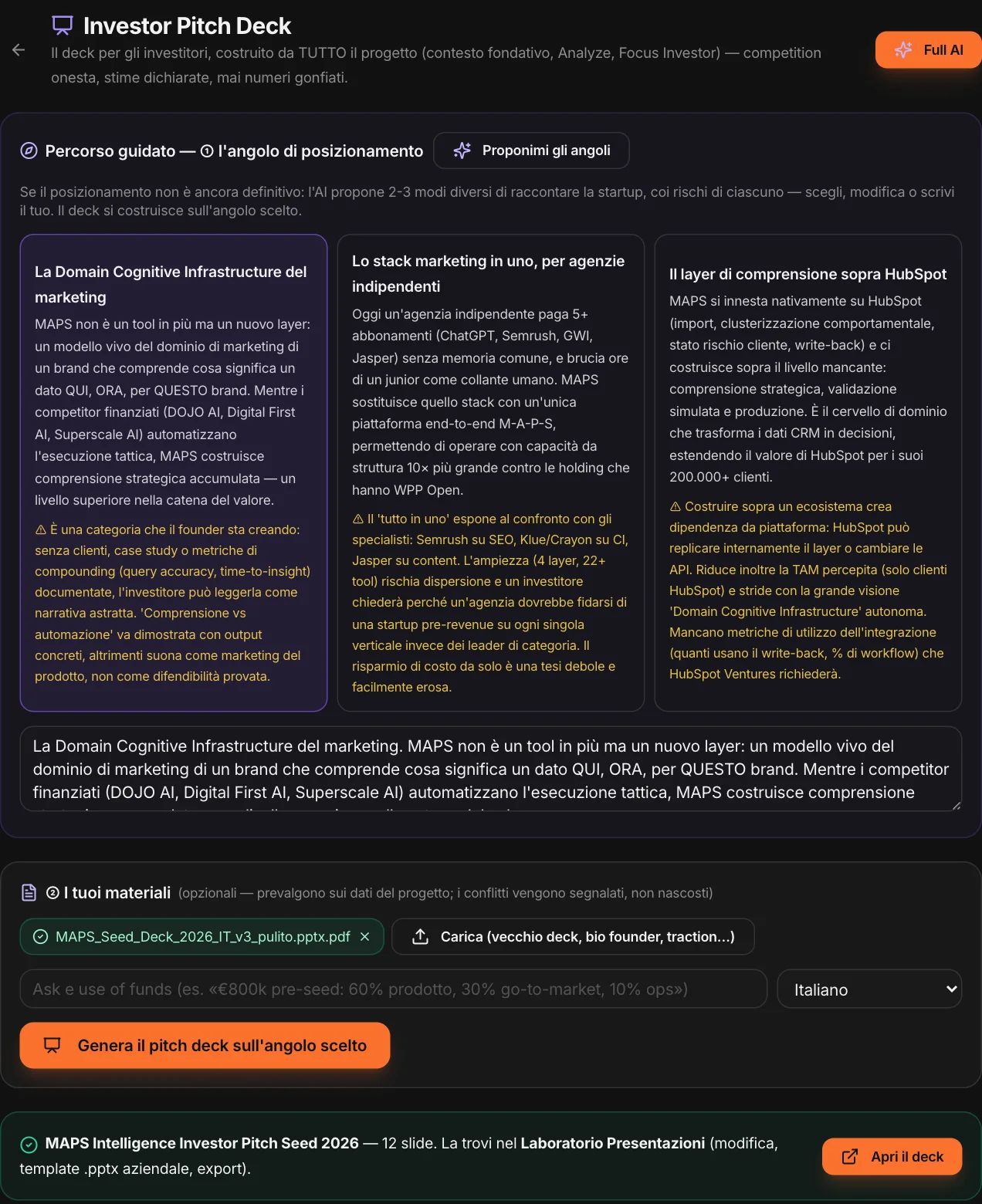
Full AI: MAPS picks the angle the data can best defend, states it up front and builds the deck. Or the guided path, in two steps: first the positioning angle, then your materials. The deck comes out in the Pitch style and lands in the Presentation Lab, ready to edit and export.
Three ways to tell your story,
with the risks of each.
When the positioning isn’t final, MAPS proposes two or three different angles, each with its thesis and — in yellow — what an investor might object. For MAPS three came out: “the new category”, with the risk of sounding like a story without proof of demand; “the all-in-one marketing stack for independent agencies”, with the risk of comparison with the specialists; “the understanding layer on top of HubSpot”, with the risk of platform dependence.
You pick one, edit it, or write your own. The angles stay saved on the project: come back the next day and they’re still there.
The new category
A living model of a brand’s marketing domain. ⚠ With no customers or metrics, it can sound like a founder’s story.
The all-in-one stack, for agencies
One platform instead of five subscriptions. ⚠ “All-in-one” invites comparison with the specialists.
The layer on top of HubSpot
Understanding, validation and production on top of the CRM. ⚠ Platform dependence, a market perceived as smaller.
The old deck, the bios,
the traction.
You upload your materials — a previous deck, the founders’ bios, the traction numbers — and write the ask and the use of funds. The founder’s materials take precedence over the project’s data; where they don’t match, the deck says so on the slide — “the founder states X, the data suggests Y” — instead of hiding it.
Choose the deck’s language: Italian, English, German, French, Spanish. For a fund in another country, it’s better to write it directly in that fund’s language than to translate it afterward.
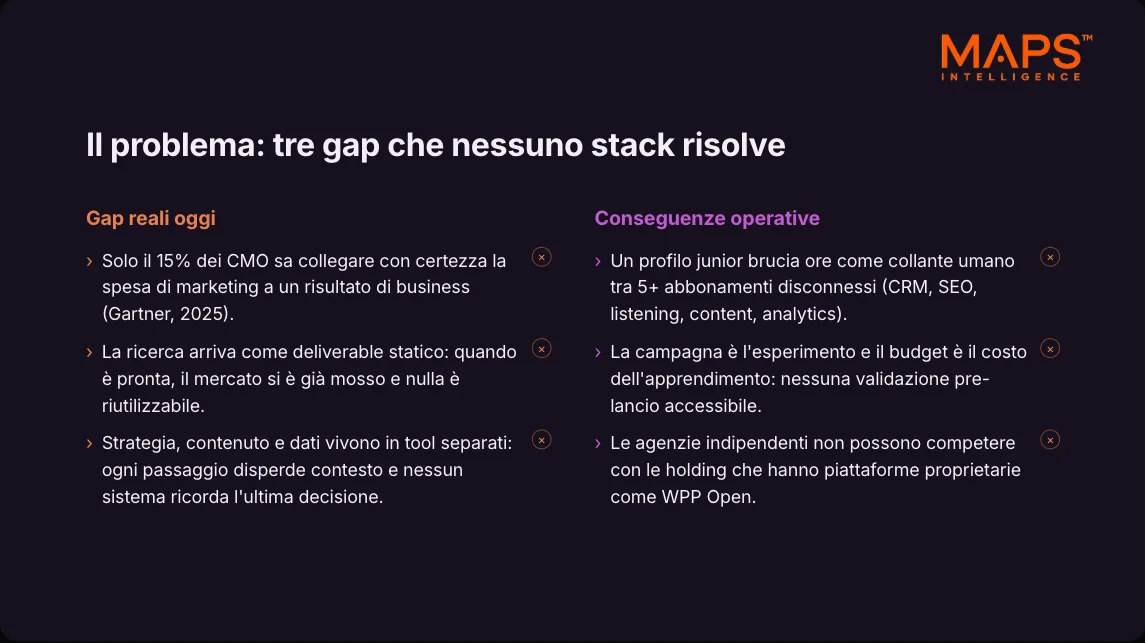
Problem
Lived, and quantified where the data allows.
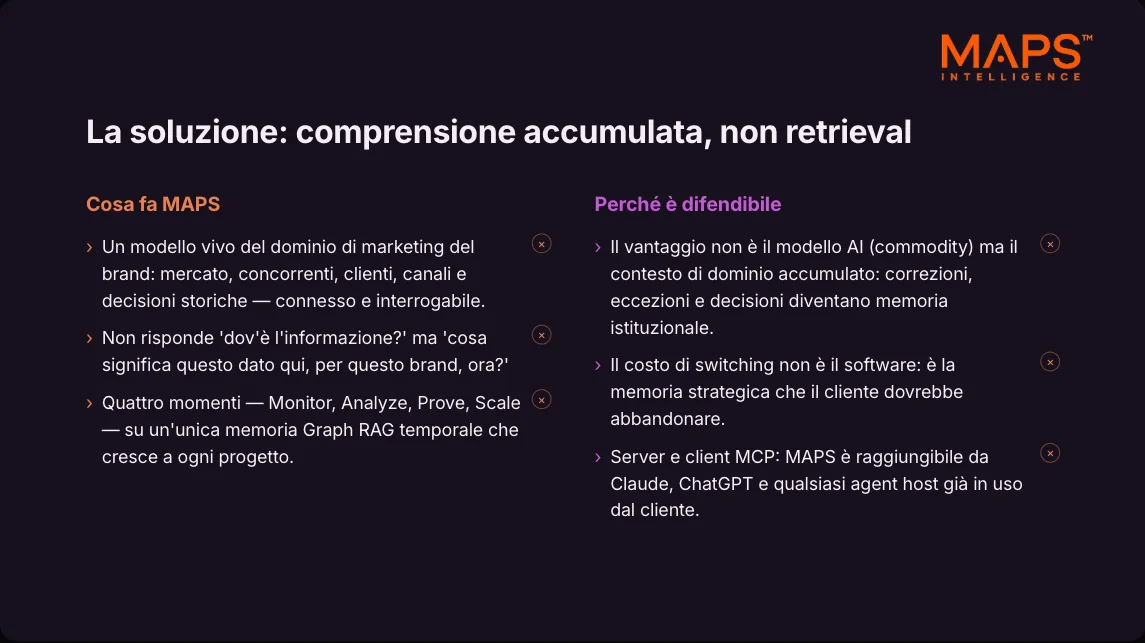
Solution and why now
What the product does, and why this is the moment.
Product
What actually exists today, not the roadmap.
Market
Stated estimates, with the reasoning: never made-up numbers.
Honest competition
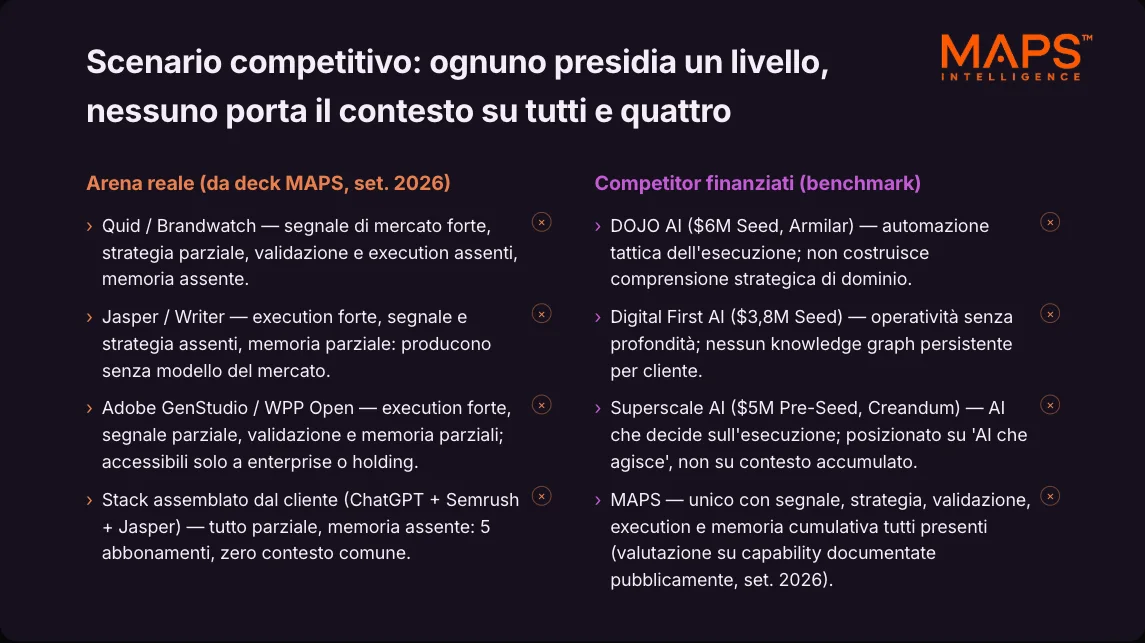
The real arena, the incumbents and the status quo: the slide investors respect.
Traction
No inflating: if the product is in alpha, the deck says so.
Team, ask, roadmap
The team from the bios, the ask and use of funds, the vision.
Twelve slides,
no fluff.
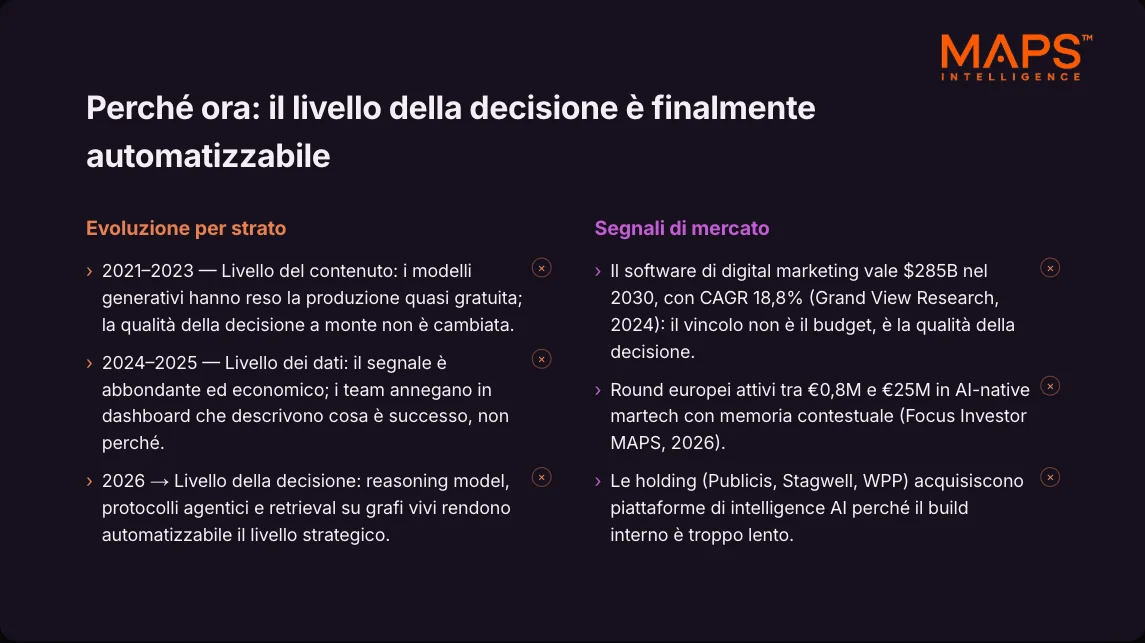
The tone of a credible founder, zero empty superlatives. Every number has a source, or is stated as an estimate. Here are five slides from the MAPS deck.

Open it,
and polish it.
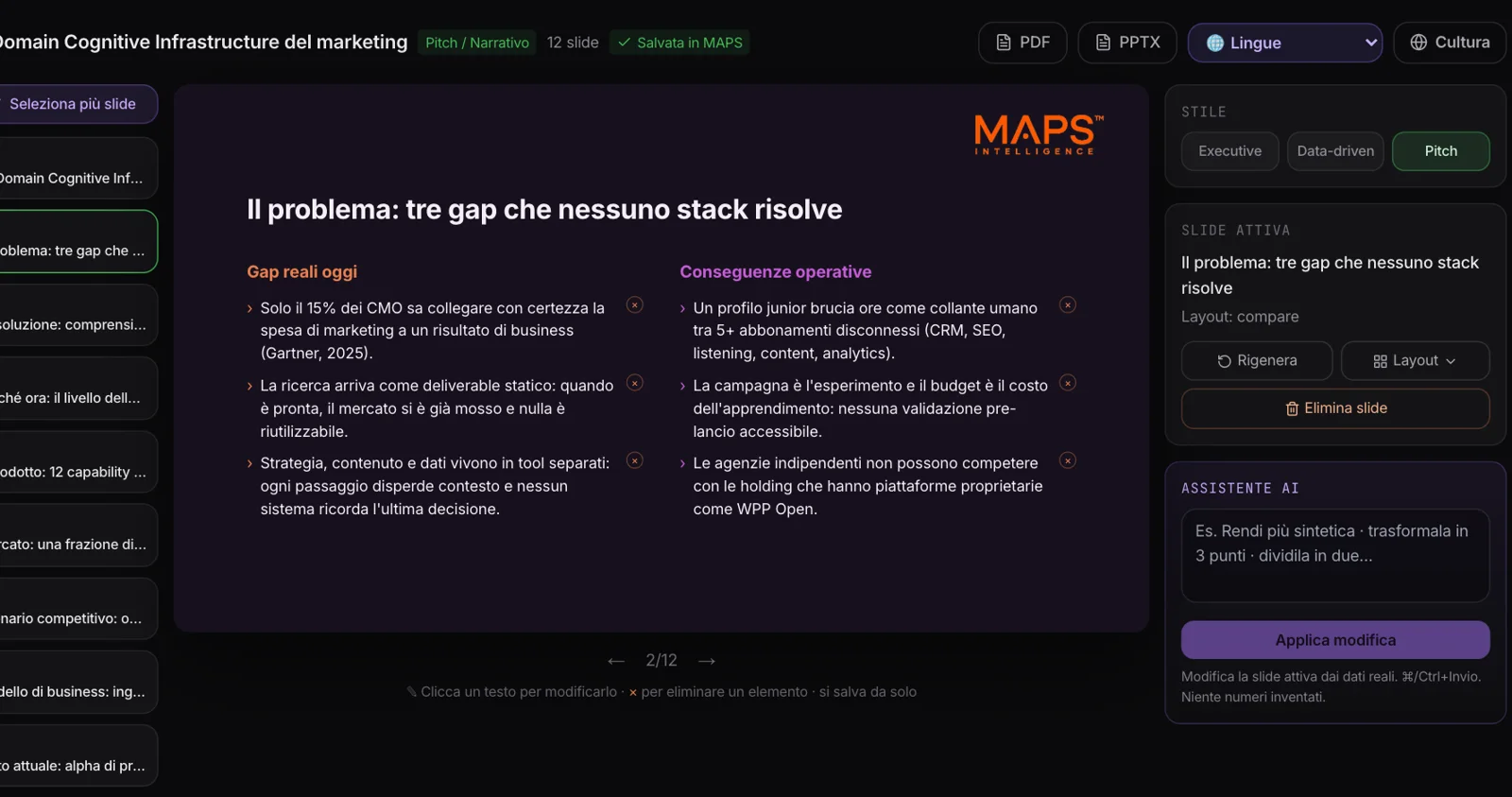
When the deck is ready, Open the deck takes you straight to the result in the Presentation Lab: edit a text in one click, ask the assistant to rewrite a slide, change the style, dress it in your company’s .pptx template. With Languages you make the version for another country, with Culture you check how it lands, and you export it to PDF or PowerPoint.