
Positioning theses,
put to the test.
You write the hypotheses, the AI proposes them, or they come from your material — a pitch, a document. Each one can be improved, varied, or debated with an AI partner that takes its weak points apart: what holds up, what doesn’t, what an investor would ask you. Then you apply.
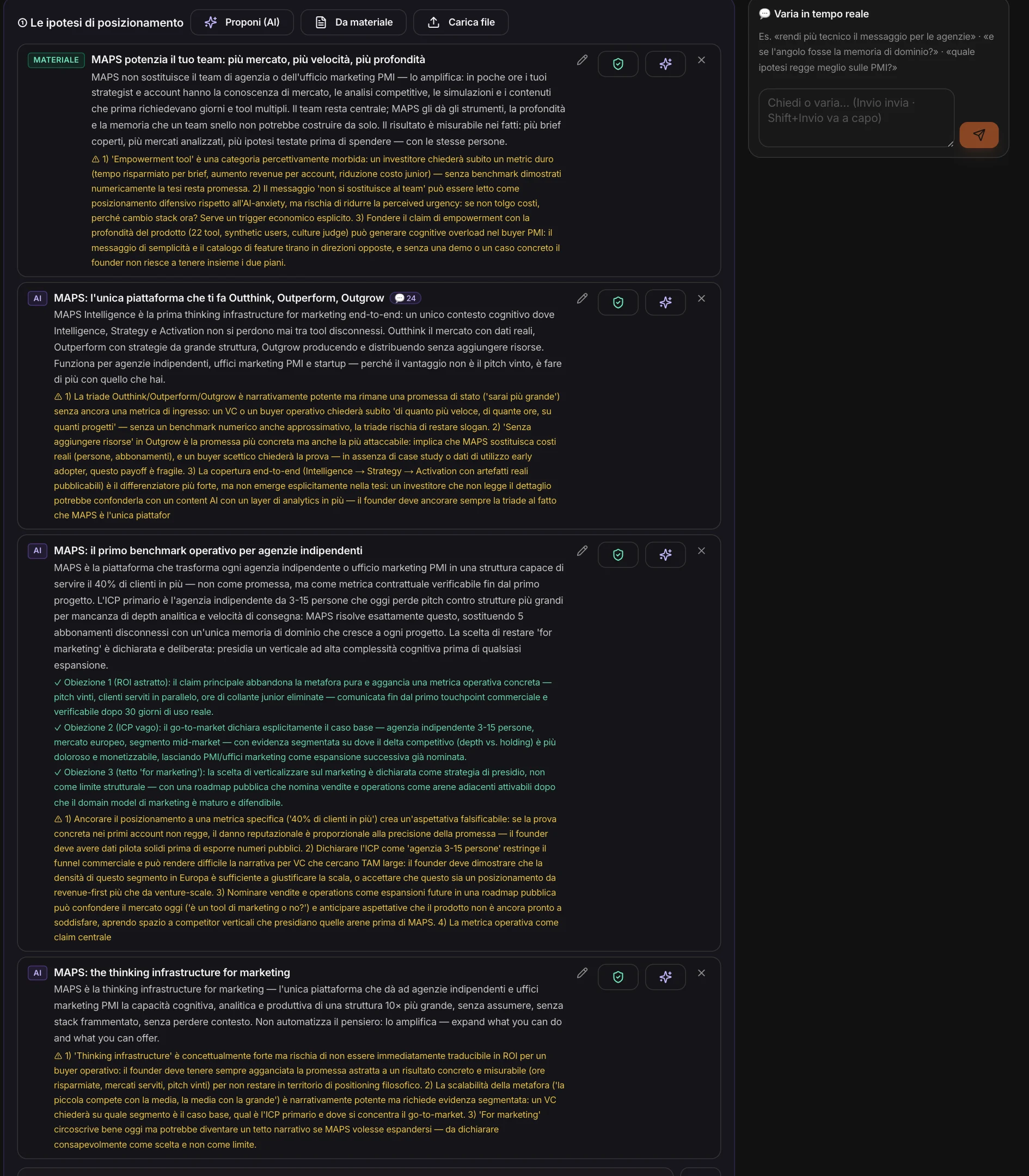
Under each hypothesis, in yellow, what the AI partner doesn’t find convincing; in green, how the thesis responded.
Every hypothesis,
on every market.
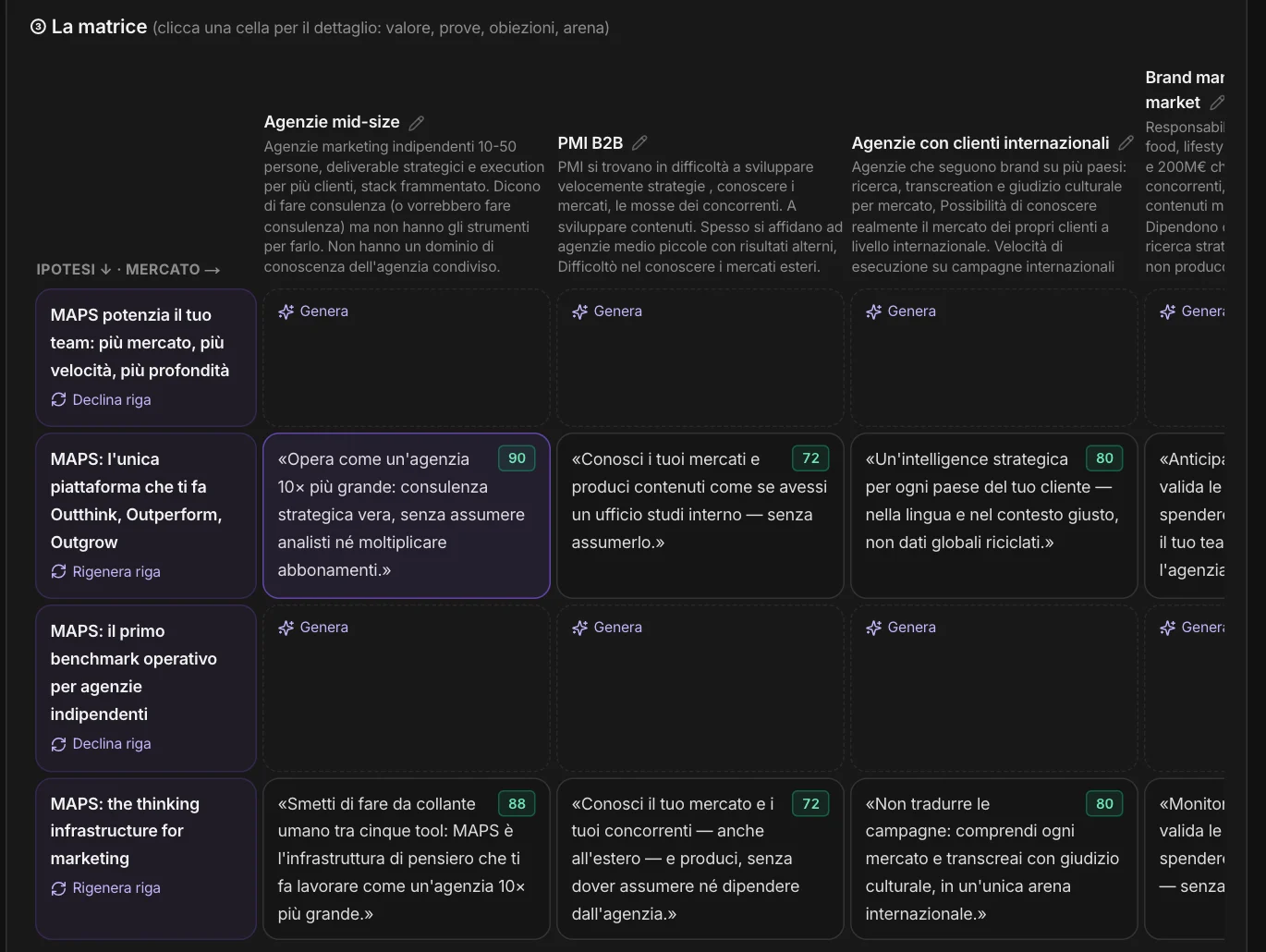
Choose the markets to test — mid-sized agencies, SMBs, companies with international clients, brand managers… — or let them be proposed. Then “Expand row”: the hypothesis is translated for each market, with its own message and its fit. You see right away where a thesis works and where it doesn’t.

What it takes
to win over that market.
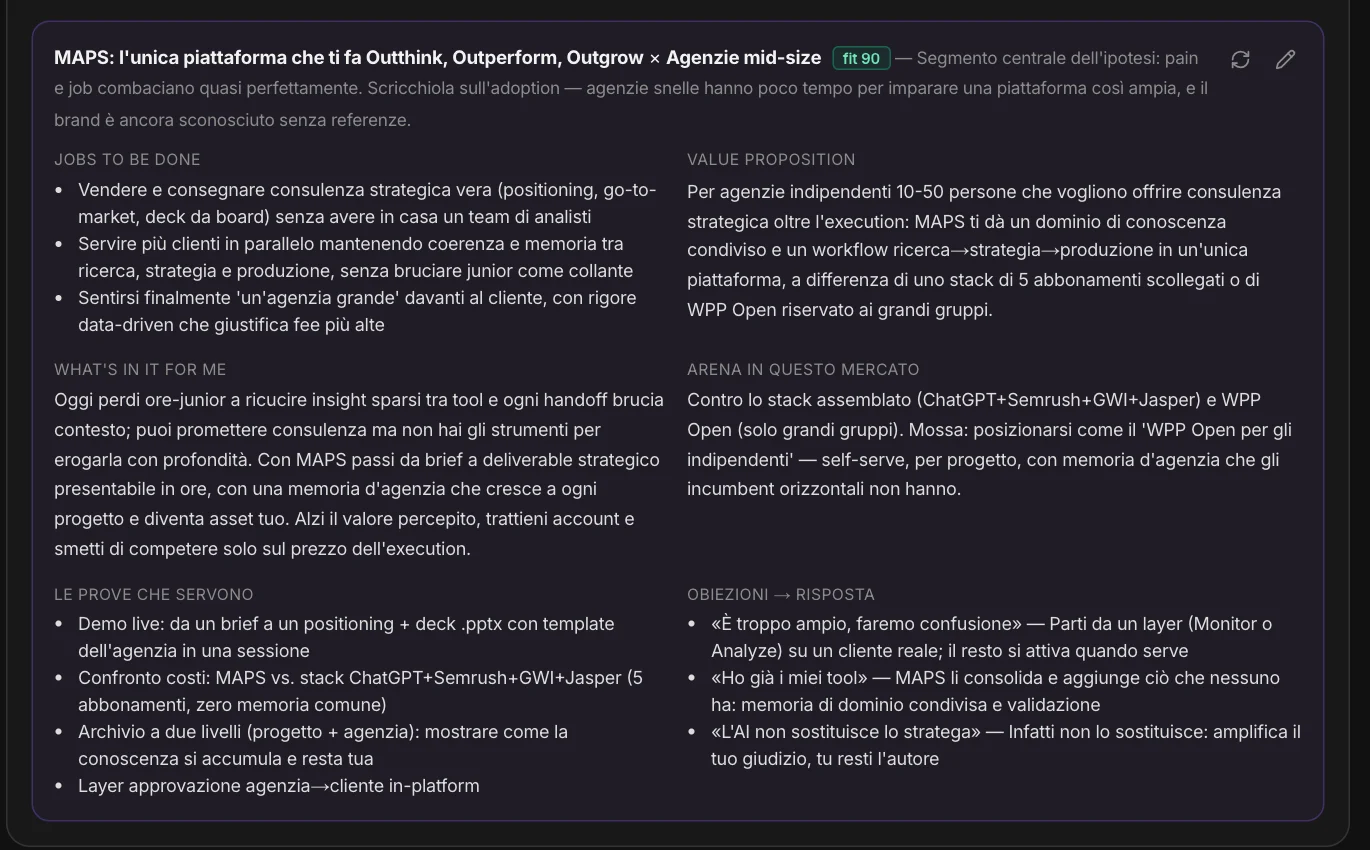
The job the customer needs to get done, the value proposition, what’s in it for them, the arena where they compare you, the proof you need, and the objections with the answer ready.
Every pivot stays.
And gets compared with the others.
Vary in real time
A chat next to the matrix: “what if we spoke to CFOs?”, “make the thesis more concrete” — and you watch it change.
Versions
Every pivot is saved as a version: you reopen them, and compare them to see what changed from one idea to the next.
In memory
Hypotheses, markets and versions enter the chat’s memory: “which hypothesis did we drop, and why?”.
Toward the value proposition
The hypotheses become directions for the Value Proposition scenarios: from the chosen positioning, what to offer.